
Overtime calculation UAE employers and employees can rely on comes down to three things: the basic wage, the normal working hours in the contract, and the time of day the extra hours were worked. Under Federal Decree-Law No. 33 of 2021 on labour relations, ordinary overtime is paid at the basic hourly rate plus at least 25%, overtime between 10 pm and 4 am at the basic hourly rate plus at least 50%, and work on a rest day earns either a substitute day off or the day’s wage plus at least 50% of the basic daily wage.
This guide walks through the rules, the formula and worked examples in AED, then shows how a time attendance system turns punches into overtime figures that payroll and employees can both check.
This is a general summary of the federal labour law for private-sector employers in the UAE, not legal advice. Free zones with their own employment laws, such as DIFC and ADGM, follow different rules.
In this guide
- Working Hours in the UAE: What the Law Says
- Overtime Rules Under Article 19
- How to Calculate Overtime in the UAE: The Formula
- Worked Overtime Examples in AED
- Who Is Excluded and Common Grey Areas
- Why Overtime Disputes Start With Attendance Data
- Setting Up Overtime Rules in Attendance Software
- Choosing Terminals That Record Overtime Reliably
- Overtime Calculation UAE FAQs
- Get a Quote for Overtime-Ready Time Attendance
Working Hours in the UAE: What the Law Says
Overtime only starts once normal hours end, so the working-hours rules come first. Article 17 of the labour law sets the maximum normal working hours at 8 hours per day or 48 hours per week.
- Breaks: an employee may not work more than 5 consecutive hours without a break, or breaks, of at least one hour in total, and break time is not counted as working time (Article 18).
- Commuting: time spent travelling between home and work is not counted as working hours, except for some categories set out in the Implementing Regulation.
- Ramadan: reduced Ramadan working hours are set by the Implementing Regulation and announced each year.
- Sector changes: the Cabinet can increase or reduce daily hours for certain sectors or categories of workers.
- Part-time and remote work: a part-time employee cannot be asked to work beyond the contracted hours without written consent, and an employer can set specific hours for remote work.
Overtime Rules Under Article 19
Article 19 is the core of every overtime calculation in the UAE. The percentages are minimums, so a contract or company policy can pay more, but never less.
| Situation | Minimum pay | Legal basis |
|---|---|---|
| Hours beyond normal working hours | Basic hourly rate plus at least 25% | Article 19(2) |
| Overtime worked between 10 pm and 4 am | Basic hourly rate plus at least 50% (does not apply to shift workers) | Article 19(3) |
| Work on the contractual rest day | A substitute rest day, or the day’s wage plus at least 50% of the basic wage for that day | Article 19(4) |
| Work on a public holiday | Another day off for each holiday worked, or the day’s wage plus at least 50% of the basic wage for that day | Article 28(2) |
The limits on overtime
- Overtime should not exceed 2 hours per day, except under the conditions in the Implementing Regulation.
- Total working hours must never exceed 144 hours in any 3 weeks.
- An employee may not be required to work more than 2 consecutive rest days, except day workers.
You can read the full text of Federal Decree-Law No. 33 of 2021 on the UAE Legislation portal.
How to Calculate Overtime in the UAE: The Formula
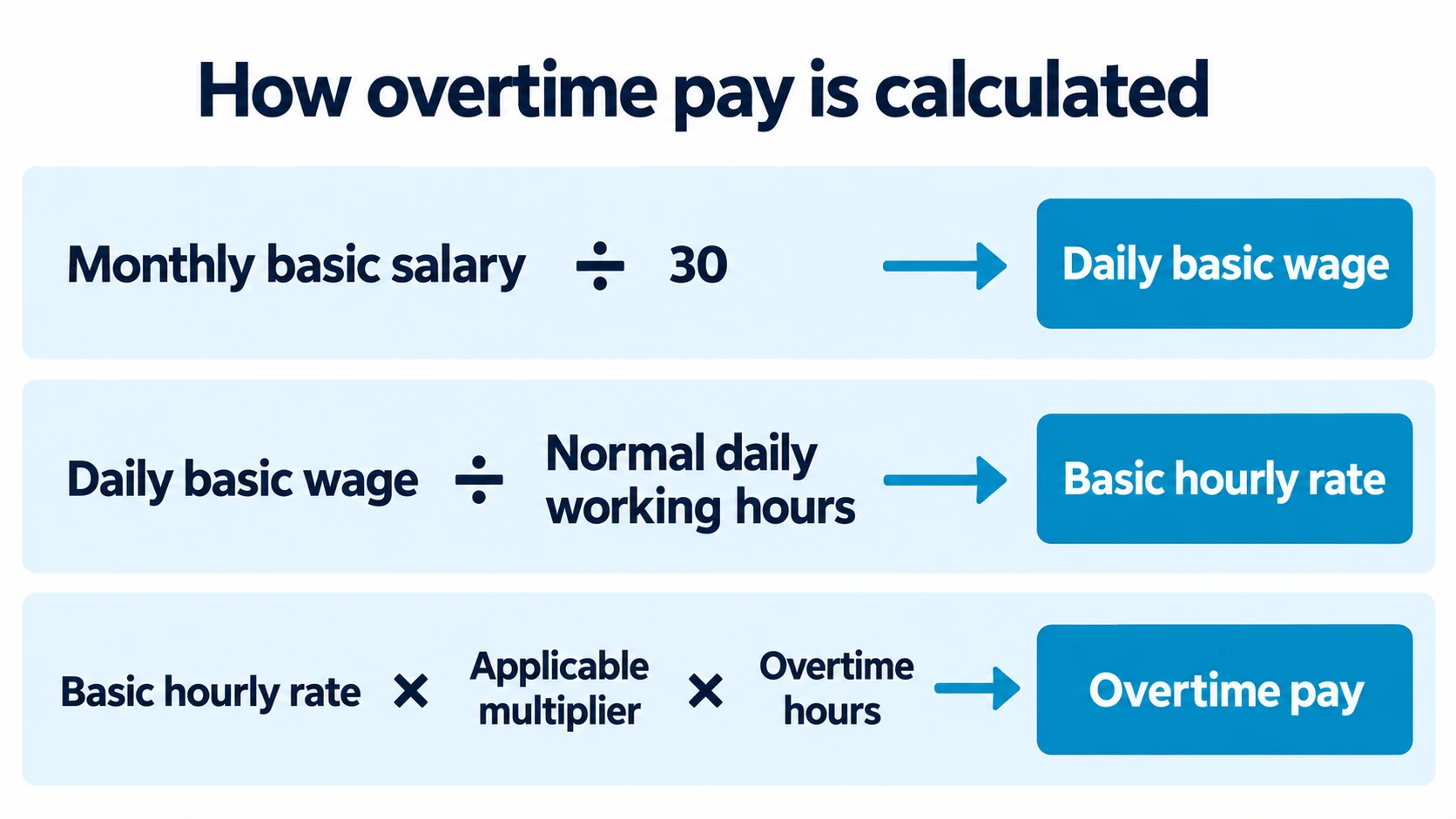
The law ties overtime to the basic wage, not the total package, so allowances such as housing and transport are normally left out unless the contract says otherwise. Article 67 counts a month as 30 days, which gives the usual method:
- Daily basic wage = monthly basic salary ÷ 30
- Basic hourly rate = daily basic wage ÷ normal daily working hours
- Overtime hourly rate = basic hourly rate × 1.25 (ordinary) or × 1.50 (10 pm to 4 am)
- Overtime pay = overtime hourly rate × overtime hours worked
If the contract sets fewer than 8 normal hours a day, use the contracted hours in step 2, because overtime begins wherever normal hours end.
Worked Overtime Examples in AED
The figures below are worked examples to show the method. They use the legal minimum percentages and an 8-hour normal day.
Example 1: ordinary and night overtime
Monthly basic salary AED 3,000.
| Step | Calculation | Result |
|---|---|---|
| Daily basic wage | 3,000 ÷ 30 | AED 100.00 |
| Basic hourly rate | 100 ÷ 8 | AED 12.50 |
| Ordinary overtime rate | 12.50 × 1.25 | AED 15.63 (15.625) |
| Night overtime rate | 12.50 × 1.50 | AED 18.75 |
| 10 ordinary overtime hours | 15.625 × 10 | AED 156.25 |
| 4 night overtime hours | 18.75 × 4 | AED 75.00 |
Example 2: a month with mixed overtime
Monthly basic salary AED 6,000, so the basic hourly rate is 6,000 ÷ 30 ÷ 8 = AED 25. In one month the employee works 10 overtime hours, 4 of them between 10 pm and 4 am.
- 6 ordinary hours × AED 31.25 = AED 187.50
- 4 night hours × AED 37.50 = AED 150.00
- Total overtime: AED 337.50
If the same employee is a shift worker, the night premium does not apply, so all 10 hours are paid at AED 31.25, a total of AED 312.50.
Example 3: working on the rest day
An employee whose daily wage is AED 100, all of it basic, works on the contractual rest day. The employer either gives another rest day or pays at least AED 100 + AED 50 = AED 150 for that day.
Who Is Excluded and Common Grey Areas
- Excluded categories: Article 20 lets the Implementing Regulation exclude certain categories of workers from the working-hours rules. Check the regulation, or ask MOHRE, before assuming a role is excluded.
- Shift workers: they still earn overtime for extra hours, but not the 50% night uplift for the 10 pm to 4 am window.
- Basic versus gross: disputes often start when the contract does not split basic salary and allowances clearly. A clear salary breakdown prevents most of them.
- Approval: the law covers overtime the work requires. A written approval step for planned overtime keeps everyone clear on which extra hours count.
- Free zones: DIFC and ADGM have their own employment laws, so their overtime rules differ from the federal law.
For official guidance, services and complaints, the Ministry of Human Resources and Emiratisation (MOHRE) is the authority for private-sector employment.
Why Overtime Disputes Start With Attendance Data
The formula is simple. The hard part is knowing exactly how many hours were worked, and when. Most overtime disagreements come from the data, not the maths:
- Manual timesheets rounded up or down, or filled in at the end of the week.
- Missed punches, where an employee clocked in but not out and nobody agreed how to treat the gap.
- Night hours not split out, so hours after 10 pm are paid at 1.25 instead of 1.50, or the other way round.
- Rest days and public holidays that are not marked in the system, so the 50% uplift or the substitute day is missed.
- No audit trail, so nobody can show who edited a record and why.
A biometric terminal records who punched and at what time, which removes buddy punching and guesswork. Our biometric attendance machine buyer’s guide explains how to choose one, and the biometric time attendance systems page covers the verification options.
Setting Up Overtime Rules in Attendance Software
The terminal captures punches. Time attendance software turns them into hours, overtime and a payroll export. Before go-live, write these rules down and configure them:
- Normal daily hours for each employee grade or shift, including Ramadan hours.
- When overtime starts: after the daily threshold, after the weekly total, or both.
- Multipliers of 1.25 for ordinary overtime and 1.50 for the 10 pm to 4 am window, or higher rates if your policy pays more.
- Which employees are shift workers, so the night uplift is applied correctly.
- The rest-day and public-holiday calendar, and whether each case earns pay or a substitute day.
- Grace periods for late arrival and early departure, and a clear missed-punch rule.
- An approval step for planned overtime, plus a report that shows hours against the 144-hour, 3-week limit.
- A payroll export in the format your payroll and WPS salary file already use.
For companies with several branches or project sites, multi-location time attendance and cloud-based time attendance devices bring every site’s punches into one record, so overtime is calculated the same way everywhere.
Choosing Terminals That Record Overtime Reliably
The right device depends on where people clock in:
- Offices and warehouses: fingerprint time attendance terminals are a proven, cost-effective choice.
- Busy entrances and hygiene-sensitive sites: face recognition time attendance is contactless and quick at shift change. The ZKTeco SpeedFace V5L reads both face and palm and connects to the cloud.
- Construction and project sites that move: the portable ZKTeco Horus E1 buffers punches locally and syncs after an outage, so night and weekend hours are not lost.
Overtime Calculation UAE FAQs
Is overtime in the UAE calculated on basic or gross salary?
On the basic wage. Article 19 calculates overtime from the wage for normal hours based on the basic wage, so allowances are usually excluded unless the contract includes them.
How many overtime hours are allowed per day in the UAE?
Up to 2 hours per day, except under conditions in the Implementing Regulation, and total working hours cannot exceed 144 hours in any 3 weeks.
What is the overtime rate for night work?
Overtime between 10 pm and 4 am is paid at the basic hourly rate plus at least 50%. Shift workers are excluded from this uplift and receive the ordinary 25% overtime rate.
How is the hourly rate worked out?
Divide the monthly basic salary by 30 to get the daily basic wage, then divide by the normal daily working hours. For a basic of AED 3,000 and an 8-hour day, that is AED 12.50 per hour.
What happens if I work on my rest day?
The employer must give another rest day, or pay the wage for that day plus at least 50% of the basic wage for that day. An employee cannot be required to work more than 2 consecutive rest days, except day workers.
Is public holiday work paid as overtime?
Under Article 28, each public holiday worked earns another day off, or the day’s wage plus at least 50% of the basic wage for that day.
Can an employer pay more than the legal overtime rate?
Yes. The 25% and 50% figures are minimums. A contract or company policy can set higher rates, and the attendance software should be configured to match.
Get a Quote for Overtime-Ready Time Attendance
If overtime is still worked out from spreadsheets at month end, the fix is accurate punches and rules configured once. Tell us how many employees and sites you have and how your shifts run, and we will recommend terminals and software set up for UAE overtime, rest-day and holiday rules.
4 Responses