
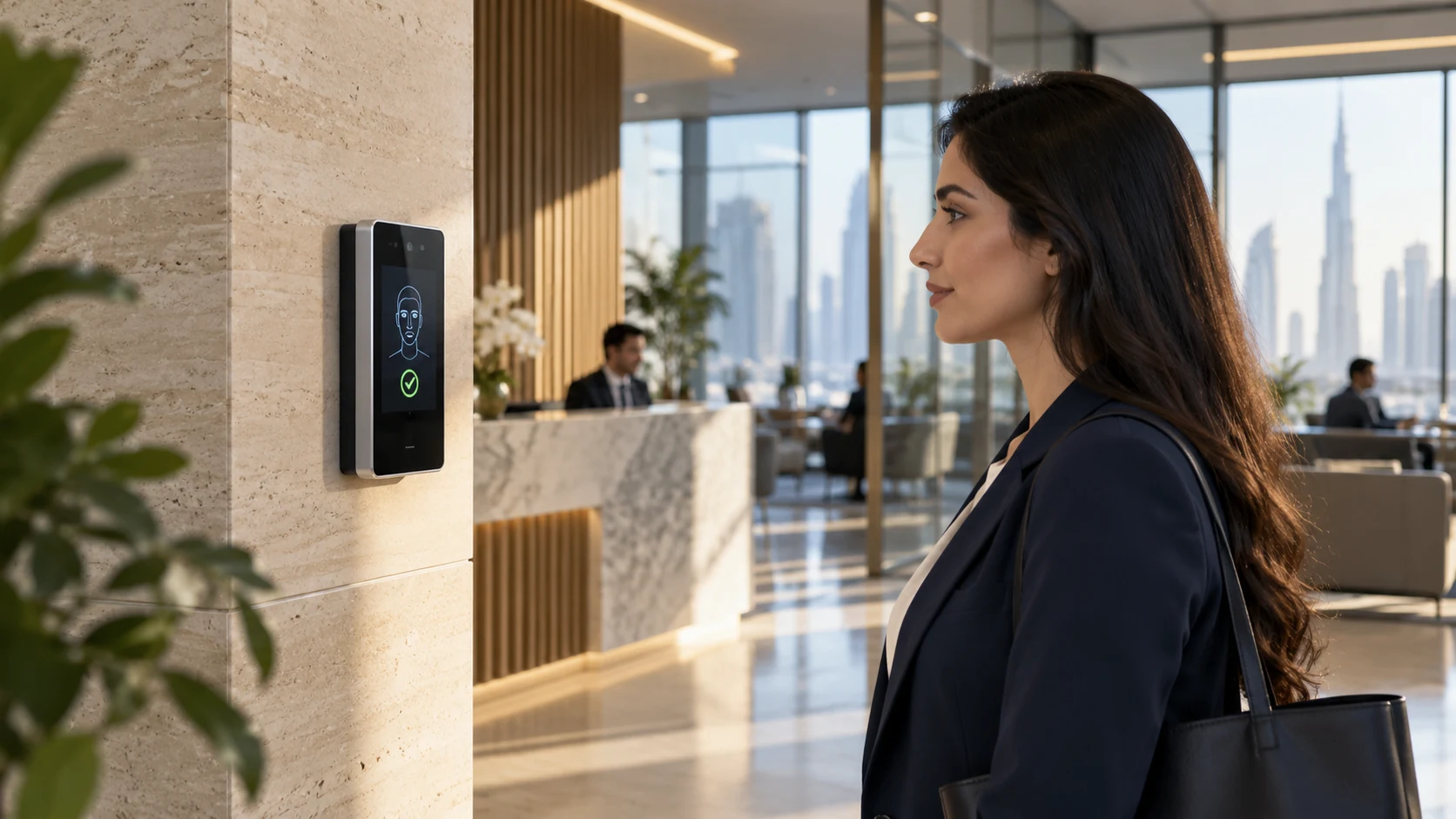
What Is a Face Recognition Attendance System?
A face recognition attendance system records clock-in and clock-out by matching an employee’s face to a stored template, without a card, PIN or fingerprint touch. In the UAE it is usually a wall-mounted or desktop terminal at the entrance, linked to time attendance software that turns each recognition into worked hours, overtime and payroll exports.
Face recognition sits inside the wider family of biometric time attendance methods. It is contactless, fast in queues and harder to share than a card, which is why offices, warehouses, clinics and construction camps increasingly prefer it for daily attendance.
- Contactless: no shared surface to touch between punches
- Fast throughput: suitable for shift changes and busy lobbies
- Harder to buddy-punch: a face template is harder to loan than a card or PIN
- Works with software: punches feed reports, overtime rules and WPS-ready payroll data
How Face Recognition Attendance Works
Most modern terminals use visible-light or near-infrared cameras and on-device algorithms. When someone approaches, the camera captures a live image, checks that it is a real face (anti-spoofing), and compares it with enrolled templates. A match creates a punch with a timestamp and user ID.
Enrolment
HR or a site supervisor enrols each employee once: usually a few face captures from slightly different angles. The device stores a biometric template, not a photo gallery for casual browsing. Templates stay on the terminal, on a local server, or in a cloud attendance platform, depending on the deployment.
Recognition at the door
At each punch the live face is checked against the template database. Recognition typically takes under a second when lighting and camera height are set correctly. Many ZKTeco Visible Light Facial Recognition devices also support mask detection and infrared fill for darker lobbies, as described in ZKTeco Visible Light Facial Recognition overview.
From punch to payroll
Software groups punches into shifts, flags missing clock-outs, applies overtime rules and exports hours for payroll. That attendance close is what UAE employers need before building a Wage Protection System salary file. See our guides on WPS salary and overtime calculation in the UAE for the payroll side.
Face Recognition vs Fingerprint vs RFID Card
Choosing a modality is usually about hygiene, gloves, lighting and how strict you need anti-buddy-punching to be. Use this comparison as a starting point, then confirm with a site survey.
| Factor | Face recognition | Fingerprint | RFID / card |
|---|---|---|---|
| Contact | Contactless | Finger on sensor | Card tap |
| Speed in queues | High when lighting is good | Medium | High |
| Buddy punching risk | Low with anti-spoofing | Low | Higher if cards are shared |
| Gloves / dirty hands | Unaffected | Often fails | Unaffected |
| Masks | Supported on many modern models | Unaffected | Unaffected |
| Typical UAE fit | Offices, clinics, hotels, high-traffic gates | Workshops, small offices | Visitors, multi-credential sites |
Many buyers keep a backup method on the same terminal (face plus fingerprint or card) for staff who cannot enrol a face, or for visitors. Browse our face recognition time attendance, fingerprint time attendance and RFID card attendance categories side by side, and use the attendance punching machine price guide for listed AED figures.
Buying Criteria for UAE Workplaces
A useful shortlist for Dubai, Abu Dhabi and other emirates looks at more than camera resolution.
1. Capacity and user count
Match face-template capacity and daily punch volume to headcount plus growth. A small clinic and a 500-worker camp need different platforms, even if both want face recognition.
2. Lighting, mounting height and outdoor use
Strong backlight from glass lobbies, night gates and dusty outdoor canopies all affect recognition. Ask for infrared illumination, adjustable mounting height (usually around face level) and an IP rating if the terminal sits outdoors or in a semi-open corridor.
3. Anti-spoofing and mask support
Look for live-face detection that rejects printed photos and phone screens. Mask tolerance matters for clinics, food production and any site that still requires face coverings in certain zones.
4. Multi-credential options
Face-only works for many offices. Sites with contractors, gloves or shared visitor flows often add fingerprint, palm or RFID on the same device so one failed modality does not stop the queue.
5. Software, cloud and multi-site
Confirm how terminals sync: local network, cloud or hybrid. Multi-branch retailers and contractors usually need cloud-based time attendance or multi-location time attendance so every site closes into one report before payroll.
6. Privacy and data handling
Facial templates are personal data. Under the UAE federal data protection framework summarised on the UAE Government data protection page, employers should limit collection to attendance purposes, control who can export templates, and keep retention rules documented. Tell staff that face recognition is used for timekeeping, not for unrelated monitoring.
7. Local supply, warranty and installation
Prefer a UAE supplier that can enrol staff, set shift rules and support the device after handover. Hardware from brands such as ZKTeco is widely available through local partners including eTOP on timeattendance.ae.
Where Face Recognition Attendance Fits Best
- Corporate offices and free-zone companies: clean lobbies, fast morning queues, professional look.
- Healthcare and labs: contactless punching supports hygiene policies.
- Hospitality and retail: shared terminals for rotating shifts without card loss.
- Warehouses and light industry: gloves and dirty hands make fingerprint sensors unreliable.
- Construction camps and project gates: high throughput at shift change; pair with sturdy mounting and good lighting.
If you are still deciding between biometric options in general, start with the biometric attendance machine buyer guide, then narrow to face when contactless throughput is the priority.
ZKTeco Face Recognition Models Commonly Used in the UAE
On timeattendance.ae the face recognition category includes entry-level and higher-capacity ZKTeco terminals. Exact features vary by model; always confirm capacity, credentials and mounting before you order.
- ZKTeco BioFace A1 – compact face terminal for smaller teams
- ZKTeco BioFace D1 – face terminal for growing sites
- ZKTeco iFace880 – multi-biometric style terminal often used where face plus other credentials help
- ZKTeco SpeedFace V5 – visible-light face terminal for higher-traffic entrances
- ZKTeco Horus and Horus E1 – Android-style platforms for richer apps and cloud workflows
Listed AED prices (excluding VAT) appear on each product page and are summarised in the attendance punching machine price guideInstallation, networking and software licences are quoted separately after a site check.
Implementation Checklist
- Map doors and headcount. Note peak queue size, outdoor vs indoor, and whether visitors need a separate path.
- Pick modality mix. Face-only, or face plus fingerprint/card/palm for backup.
- Choose software. Decide on-premise vs cloud and how overtime and leave will be approved.
- Plan enrolment day. Book time for HR to enrol faces and issue backup credentials.
- Test lighting and height. Run a pilot at the real door before rolling out every floor.
- Connect to payroll. Confirm the export format your payroll or WPS agent needs.
- Document privacy. Keep a short notice for employees and a retention rule for templates.
Face Recognition Attendance FAQs
Is a face recognition attendance system legal in the UAE?
Employers commonly use biometric attendance when it is limited to legitimate work purposes such as timekeeping. Treat face templates as personal data, follow the UAE data protection principles summarised by the government portal, and tell employees how the system is used.
Does face recognition work with masks?
Many current terminals support masked faces, but accuracy still depends on the model and lighting. Ask for a live demo with the mask types your staff actually wear.
What happens if lighting is poor?
Near-infrared illumination and correct mounting height solve most lobby and night-gate issues. Outdoor gates may need a canopy or an IP-rated housing.
Can face recognition replace fingerprint completely?
Often yes for offices and clinics. Sites with heavy PPE, identical uniforms at long distance, or frequent contractor turnover may keep fingerprint or RFID as a fallback on the same device.
How is this different from access control face readers?
Attendance terminals focus on time records and payroll exports. Access control readers open doors or turnstiles. Some devices do both; confirm whether you need attendance only, access only, or a combined setup.
Do I need special software?
You need attendance software that receives punches, applies shift rules and exports hours. See our time attendance software page for how that connects to terminals.
How much does a face recognition attendance system cost?
Hardware list prices vary by model and features. Use the price guide for published AED figures on our store, then request a quote for installation, software and enrolment.
Get a Face Recognition Attendance Quote
Tell us your headcount, number of doors and whether you need cloud multi-site reporting. We will recommend ZKTeco face recognition terminals and software that fit your UAE sites, including enrolment support and a clear quote for hardware and installation.